



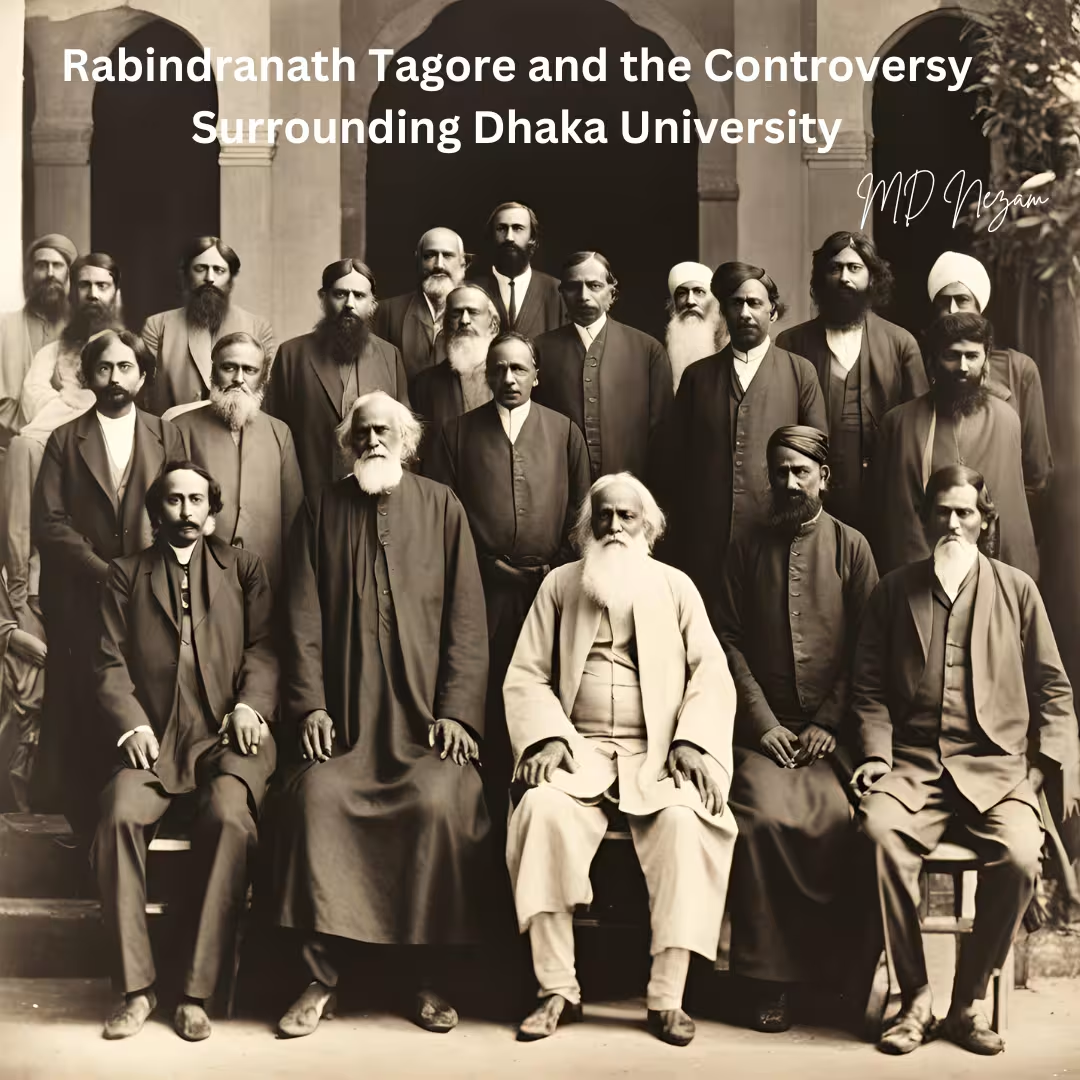
Rabindranath Tagore and the Dhaka University Debate: History, Controversy, and Legacy
Rabindranath Tagore is one of the most celebrated figures in South Asian history. A Nobel Prize-winning poet, philosopher, educator, and cultural icon, his influence extends across literature, music, education, and politics.
Yet, like many influential historical figures, Tagore’s legacy is not without debate. One of the most discussed controversies in modern Bangladesh concerns his position during the establishment of Dhaka University in the early twentieth century.
More than a century later, historians continue to examine Tagore’s role, the political climate of British India, and the competing visions for higher education that shaped the debate.
The Historical Background of Dhaka University
The idea of establishing a university in Dhaka emerged following the Partition of Bengal in 1905 and the subsequent political developments that followed.
At the time, higher education in Bengal was largely concentrated in Calcutta (now Kolkata). Many Muslim leaders from East Bengal argued that the region lacked sufficient educational institutions and opportunities compared to western parts of Bengal.
In response to these concerns, British authorities proposed establishing a university in Dhaka. The institution was eventually founded in 1921 and would later become one of South Asia’s most important centers of higher education.
Today, Dhaka University is widely regarded as the intellectual heart of Bangladesh and played a crucial role in the Language Movement of 1952, the democratic movements of the 1960s, and the Liberation War of 1971.
Did Rabindranath Tagore Oppose Dhaka University?
This question remains one of the most debated topics in Bengali intellectual history.
Historical records confirm that Tagore participated in discussions and public meetings related to educational policies during the period when the proposed university was being debated.
Some researchers argue that Tagore opposed the specific plan for establishing Dhaka University, believing that it might weaken existing educational institutions and divert limited educational resources.
Others contend that his position has been misunderstood and that his concerns focused more on educational policy, funding priorities, and academic standards rather than opposition to higher education in East Bengal itself.
Because historians continue to interpret these events differently, there is no universal consensus regarding the exact nature and motivation behind Tagore’s position.
Education, Class, and Colonial Bengal
To understand the controversy, it is important to examine the social realities of colonial Bengal.
Early twentieth-century Bengal was deeply divided by:
- Economic inequality
- Religious differences
- Educational disparities
- Political competition
- Class divisions
Educational opportunities were often concentrated among urban elites, while many rural communities, including large sections of the Muslim population in East Bengal, had limited access to higher education.
As debates over educational expansion intensified, disagreements emerged regarding where universities should be built, who should receive funding, and how educational resources should be distributed.
The Dhaka University debate became part of these larger political and social discussions.
Tagore’s Vision for Education
Regardless of where one stands on the Dhaka University controversy, Tagore’s commitment to education is well documented.
In 1921, he founded Visva-Bharati at Santiniketan, an institution designed to promote international learning, cultural exchange, and interdisciplinary education.
Tagore believed education should:
- Encourage creativity
- Promote critical thinking
- Connect students with nature
- Foster global understanding
- Move beyond rigid colonial educational models
His educational philosophy continues to influence institutions across the world today.
Why the Debate Still Matters
The controversy surrounding Tagore and Dhaka University remains relevant because it touches on broader questions about history and national identity.
Supporters of Tagore argue that:
- His contributions to literature are unmatched.
- His educational vision was progressive for its time.
- Historical evidence regarding his opposition is often interpreted selectively.
Critics argue that:
- He represented elite interests within colonial Bengal.
- He did not sufficiently support educational advancement in East Bengal.
- His actions should be evaluated within the social inequalities of his era.
These differing interpretations demonstrate how historical figures can be viewed through multiple perspectives.
Tagore’s Enduring Connection to Bangladesh
Despite the controversy, Rabindranath Tagore occupies a unique place in Bangladesh’s cultural identity.
His song “Amar Sonar Bangla” became the national anthem of Bangladesh following independence in 1971.
His literary works continue to be studied in schools and universities throughout the country, while his influence remains visible in music, literature, and cultural life.
As a result, Tagore remains both a celebrated cultural icon and a subject of historical debate.
Looking Back from 2026
More than one hundred years after the founding of Dhaka University, discussions about Rabindranath Tagore’s role continue to generate interest among historians, educators, and readers.
The debate reflects larger questions about colonial history, educational opportunity, social inequality, and national identity in Bengal.
Whether viewed as a visionary educator, a literary genius, a representative of elite society, or a complex combination of all three, Tagore remains one of the most important figures in South Asian history.
Understanding both his achievements and the controversies surrounding his legacy allows for a more complete picture of Bengal’s intellectual and political evolution.
🧠 Expand Your Knowledge
If you found this article valuable, explore more expert guides, reviews, and historical analyses from Info-Sir:
📱 iPhone Comparison Guide
https://info-sir.com/iphone-17-vs-iphone-16-all-models/
🌴 Lattafa Khamrah Waha Review (2026)
https://info-sir.com/lattafa-khamrah-waha-review/
📸 Samsung Flagship Comparison
https://info-sir.com/samsung-galaxy-s25-ultra-vs-samsung-galaxy-s24-ultra/
👶 Ultimate Guide to Choosing the Perfect Baby Stroller
https://info-sir.com/ultimate-guide-to-choosing-the-perfect-baby-stroller/
🤖 Anthropic (Claude) May Be the Only $1 Trillion IPO Worth Watching in 2026
https://info-sir.com/anthropic-claude-trillion-dollar-ipo-2026/
📖 Bangladesh and Sheikh Mujibur Rahman: Independence, Leadership, and a Lasting Legacy
https://info-sir.com/bangladesh-mujib-legacy/
Written by MD Nezam


In September 29, 1926, Rabindranath Tagore visited Jagannath Hall and wrote a famous poem for ‘Bashantika’ the weekly magazine of Jagannath Hall.
বাংলাদেশের জাতীয় সংগীত
আমার সোনার বাংলা, আমি তোমায় ভালোবাসি।
চিরদিন তোমার আকাশ, তোমার বাতাস, আমার প্রাণে বাজায় বাঁশি।
ও মা, ফাগুনে তোর আমের বনে ঘ্রাণে পাগল করে,
মরি হায়, হায় রে –
ও মা, অঘ্রানে তোর ভরা ক্ষেতে আমি কী দেখেছি মধুর হাসি।
কী শোভা, কী ছায়া গো, কী স্নেহ, কী মায়া গো-
কী আঁচল বিছায়েছ বটের মূলে, নদীর কূলে কূলে।
মা, তোর মুখের বাণী আমার কানে লাগে সুধার মতো,
মরি হায়, হায় রে-
মা, তোর বদনখানি মলিন হলে, ও মা, আমি নয়নজলে ভাসি।
Rabindranath Tagore and Dhaka University.(রবীন্দ্রনাথ ঠাকুর ও ঢাকা বিশ্ববিদ্যালয়।
“Ravi Tagore’s opposition to the establishment of Dhaka University was justified by the environmental conditions of the time.”
🌟 Opposition to Ravi Tagore ✒
It is said that Rabindranath Tagore opposed the establishment of Dhaka University.
For this reason, it may seem outwardly that Rabindranath Tagore at that time prevented the people of East Bengal from being educated.
But at that time there were some real reasons for opposition to Rabindranath Tagore. At that time the condition of East Bengal was not as good as it is now. Rather the communication system was extremely miserable.
But there were many educational institutions in that proportion. There were many other educational institutions including Jagannath College, Anandamohan College, which were suitable for the miserable communication system of that time.
At present there are Bangladesh Agricultural University, Anandamohan College, Nazrul University, Mymensingh Medical College etc. in Mymensingh. Now if anyone says, to establish another educational institution like Dhaka University in Mymensingh city. So will another educational institution like Dhaka University be established in Mymensingh city? For good reason, almost everyone will disagree. The situation is similar to the situation in East Bengal at that time, the situation was similar to the establishment of Dhaka University. Therefore, in the context of that time, the opposition of Ravi Tagore was not at all unreasonable.
Nevertheless, when the University of Dhaka was being established on the initiative of Nawab Sir Salimullah, the opposition of Rabindranath Tagore was not entirely unrealistic.
Moreover, Nawab Sir Salimullah may have had personal reasons for establishing Dhaka University. For example, he may have been particularly keen on establishing the University of Dhaka to separate East Bengal from the Calcutta-centric education system. The way he founded the Muslim League to separate Muslims from Congress politics. Perhaps realizing this, Ravi Tagore opposed the establishment of Dhaka University by Nawab Sir Salimullah.
And for this reason Rabindranath Tagore should never be called a hater of East Bengal. Because he composed his time-honored song, “My Golden Bangla, I Love You”, fascinated by the beauty and natural environment of East Bengal and resides in this East Bengal. He composed the songs in East Bengal. And most of the short stories he has written are based on various events in East Bengal. And he has composed many poems and songs based in East Bengal.
After the establishment of Dhaka University, Ravi Tagore traveled to East Bengal. If he had been a hater of East Bengal, he would never have done so.
Therefore, it is absolutely unreasonable to oppose Ravi Tagore by issuing opposition to the establishment of Dhaka University by Ravi Tagore.
ঢাকা বিশ্ববিদ্যালয় প্রতিষ্ঠা না করার জন্য ইংরেজদের কাছে একে একে ১৭ বার স্মারকলিপি দিয়েছিল রবী*ন্দ্রনাথ ঠাকুর।
[…] Rabindranath Tagore and the Controversy Surrounding Dhaka University: A Complex Legacy […]