



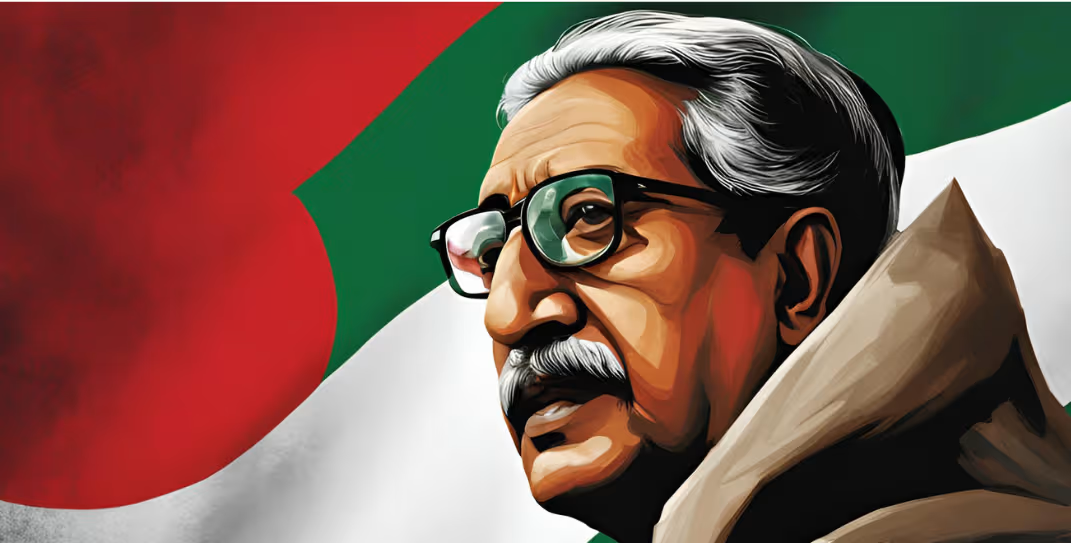
Bangladesh’s journey to independence is one of the most significant chapters in South Asian history. At the center of that story stands Sheikh Mujibur Rahman, a leader whose role in the birth of Bangladesh is widely recognized, yet whose legacy continues to spark debate more than five decades after independence.
For many Bangladeshis, Sheikh Mujib is the visionary leader who inspired a nation to fight for self-determination. For others, his post-independence governance raises important questions about democracy, economic management, and political centralization. Understanding his legacy requires examining both his achievements and the challenges of the era in which he governed.
The Origins of Bangladesh
The name “Bangladesh” combines two Bengali words: “Bangla” and “Desh,” meaning “the land of Bengal.” Long before independence in 1971, the term appeared in Bengali literature, poetry, and political discourse as an expression of cultural and linguistic identity.
The roots of Bangladesh’s independence movement can be traced to the creation of Pakistan in 1947. Although East Pakistan and West Pakistan were part of the same country, they were separated by more than 1,600 kilometers of Indian territory and differed significantly in language, culture, and economic conditions.
Over the following decades, many people in East Pakistan felt politically marginalized and economically disadvantaged. Key events such as the Language Movement of 1952, the Six-Point Movement of 1966, and the 1970 general election strengthened demands for greater autonomy.
The political crisis eventually escalated into the Liberation War of 1971, leading to the emergence of Bangladesh as an independent nation.
Sheikh Mujibur Rahman and the Road to Independence
Sheikh Mujibur Rahman emerged as the most influential political leader of East Pakistan during the 1960s.
As leader of the Awami League, he advocated greater autonomy for East Pakistan through his Six-Point Program. Following the Awami League’s victory in Pakistan’s 1970 general election, political negotiations between East and West Pakistan broke down, creating a constitutional crisis.
On March 7, 1971, Sheikh Mujib delivered his historic speech at the Racecourse Ground in Dhaka, a speech that many historians consider a turning point in the independence movement.
Although he was arrested by Pakistani authorities shortly after the military crackdown began on March 25, 1971, his leadership became a symbol of resistance throughout the Liberation War.
Following Bangladesh’s victory in December 1971, Sheikh Mujibur Rahman returned to a newly independent country and became its first Prime Minister.
The Challenges of Building a New Nation
The Bangladesh that emerged in 1971 faced enormous difficulties.
The war had devastated infrastructure, disrupted the economy, and displaced millions of people. Rebuilding the country required addressing widespread poverty, food shortages, administrative challenges, and political instability.
The government under Sheikh Mujib pursued policies aimed at reconstruction, nationalization of major industries, and establishing the foundations of a new state.
However, these efforts were accompanied by significant difficulties.
The country experienced economic hardship, administrative inefficiencies, corruption, and growing public dissatisfaction. The famine of 1974, which caused widespread suffering, became one of the most controversial and tragic events of the early years of independence.
Many historians continue to debate the extent to which government policies, global economic conditions, natural disasters, and administrative failures contributed to the crisis.
BAKSAL and the Debate Over Democracy
One of the most debated aspects of Sheikh Mujibur Rahman’s leadership was the creation of BAKSAL (Bangladesh Krishak Sramik Awami League) in 1975.
Through the Fourth Amendment to the Constitution, Bangladesh moved toward a presidential system and a one-party political structure.
Supporters argued that the move was intended to stabilize a country facing political violence, economic challenges, and administrative breakdown.
Critics, however, viewed BAKSAL as a departure from democratic principles. They argued that restrictions on political opposition and press freedom concentrated too much power in the hands of the government.
The debate over BAKSAL remains one of the most contested topics in Bangladesh’s political history.
The Assassination of Sheikh Mujibur Rahman
On August 15, 1975, Sheikh Mujibur Rahman was assassinated during a military coup.
Most members of his family who were present at his residence were also killed in the attack. The assassination shocked the nation and marked a turning point in Bangladesh’s political development.
The event ushered in a prolonged period of political instability, military influence in governance, and significant constitutional changes.
Historians continue to examine the political, economic, and institutional factors that contributed to the conditions leading up to the coup.
A Legacy That Continues to Shape Bangladesh
More than fifty years after independence, Sheikh Mujibur Rahman remains one of the most influential figures in Bangladesh’s history.
His supporters remember him as:
- The leader of the independence movement
- The architect of the Six-Point Movement
- The central political figure behind Bangladesh’s creation
- The Father of the Nation
His critics point to:
- Economic challenges during his administration
- Governance failures
- The 1974 famine
- The creation of BAKSAL
- The concentration of political power
Both perspectives form part of the broader historical discussion surrounding his legacy.
Looking Back from 2026
As Bangladesh continues its economic and social transformation, debates about Sheikh Mujibur Rahman’s legacy remain highly relevant.
Modern Bangladesh has become one of South Asia’s fastest-growing economies, yet discussions about democracy, governance, political institutions, and national identity often return to the decisions made during the country’s formative years.
Whether viewed primarily as a founding father, a revolutionary leader, a nation-builder, or a controversial political figure, Sheikh Mujibur Rahman’s influence on Bangladesh is undeniable.
His story reflects both the achievements and the challenges of building a nation from the aftermath of war, making him one of the most important and debated figures in Bangladesh’s history.
🧠 Expand Your Knowledge
If you found this article valuable, explore more expert guides, reviews, and historical analyses from Info-Sir:
📱 iPhone Comparison Guide
https://info-sir.com/iphone-17-vs-iphone-16-all-models/
🌴 Lattafa Khamrah Waha Review (2026)
https://info-sir.com/lattafa-khamrah-waha-review/
📸 Samsung Flagship Comparison
https://info-sir.com/samsung-galaxy-s25-ultra-vs-samsung-galaxy-s24-ultra/
👶 Ultimate Guide to Choosing the Perfect Baby Stroller
https://info-sir.com/ultimate-guide-to-choosing-the-perfect-baby-stroller/
🤖 Anthropic (Claude) May Be the Only $1 Trillion IPO Worth Watching in 2026
https://info-sir.com/anthropic-claude-trillion-dollar-ipo-2026/
📖 Bangladesh and Sheikh Mujibur Rahman: Independence, Leadership, and a Lasting Legacy
https://info-sir.com/bangladesh-mujib-legacy/
Written by MD Nezam


